How to Last Longer in Bed: 9 Evidence-Based Ways to Improve Control
11 min read
If you want to last longer during sex, focus less on chasing a specific number of minutes and more on improving control over your arousal and ejaculation. Control is a skill you can practise. Duration on its own tells you very little about whether sex was good.

Quick answer: how to last longer in bed
- Learn to recognize when your arousal is approaching the point where ejaculation becomes difficult to stop.
- Slow down or briefly pause stimulation before reaching that point.
- Practice behavioral techniques such as stop-start.
- Use a thicker condom if reducing penile stimulation helps.
- Consider pelvic-floor training when appropriate — but don't assume more Kegels are always the answer.
- Reduce unnecessary muscular tension and performance anxiety.
- Adjust pace and stimulation instead of maintaining maximum-intensity penetration.
- Address erection problems if fear of losing your erection makes you rush.
- See a healthcare professional if finishing sooner than you want happens consistently and causes distress.
What does “lasting longer” actually mean?
There is no single amount of time that every man is supposed to last. Sexual preferences vary enormously, and taking longer to ejaculate does not automatically make sex better.
A more useful goal is being able to recognize and regulate your arousal well enough that ejaculation feels more voluntary rather than inevitable.
Occasionally ejaculating sooner than you wanted is also normal and does not automatically mean you have premature ejaculation. Clinical definitions consider more than duration alone: they also look at your ability to delay ejaculation and whether the problem causes distress or relationship difficulties.
If ejaculation consistently happens much sooner than you want and you feel you have little or no control over it, that pattern deserves proper assessment. For everyone else, the strategies below help you work on control without turning sex into a stopwatch exercise.
1. Learn to recognize your arousal before it becomes uncontrollable
One of the most useful skills for lasting longer is noticing the difference between high arousal and the point where ejaculation is already inevitable.
Many men only try to slow down once they are already extremely close to orgasm. At that point, reducing stimulation may be too late. Start paying attention earlier.
You can think about arousal on a rough scale from 1 to 10. The numbers are not scientific measurements — they are a practical way to become more aware of your own responses.
| Arousal | What it may feel like |
|---|---|
| 1–3 | Mildly aroused |
| 4–5 | Comfortable sexual stimulation |
| 6–7 | Strong arousal but still controllable |
| 8 | Approaching ejaculation |
| 9 | Very difficult to stop |
| 10 | Ejaculation |
The goal is to learn what your 6, 7 and 8 feel like. Instead of repeatedly pushing straight from moderate to maximum stimulation, practice moving up and down: 4 → 6 → 7 → slow down → 5 → increase stimulation again.
Over time, this turns sex from a straight sprint toward ejaculation into something you have more opportunity to regulate.
2. Stop-start technique — slow down before you need to stop
Many men trying to last longer focus entirely on stopping ejaculation. A better approach is often to prevent arousal from escalating so quickly in the first place.
If you notice yourself approaching ejaculation
- Slow the rhythm.
- Reduce the depth or intensity of movement.
- Pause penetration briefly.
- Switch to another type of stimulation.
- Allow your arousal to decrease before continuing.
This principle forms the basis of several behavioral methods used for ejaculation control. The best known is the stop-start technique, where stimulation is reduced or stopped before ejaculation and resumed after arousal decreases. Behavioral approaches have been studied for premature ejaculation, although the quality of the evidence varies between techniques and studies.
The important idea is simple: don't wait until ejaculation feels inevitable before changing what you are doing.
3. Squeeze technique as another control strategy
Another traditional behavioral method is the squeeze — or pause-squeeze — technique. The basic principle is similar to stop-start training: stimulation is interrupted when ejaculation feels close, allowing arousal to decrease before sexual activity resumes.
When you feel you are getting close to orgasm
- Stop stimulation.
- Gently squeeze the penis, usually just below the head.
- Hold the pressure for about 10–20 seconds.
- Wait until the urge to ejaculate decreases.
- Start stimulation again.
The idea is to lower arousal briefly so you can regain control before reaching the point of no return. It is not necessary for every man, and some people find stop-start easier or more comfortable.
4. Reduce penile stimulation when sensitivity is part of the problem
For some men, reducing sensation slightly makes it easier to avoid reaching ejaculation too quickly. A simple first option is a thicker condom.
A thicker condom can be especially useful if you
- become highly stimulated very quickly
- find penetration considerably more stimulating than other sexual activity
- don't want to use medication
The objective is not to eliminate sensation entirely. Too little sensation may reduce pleasure or make it harder to maintain an erection.
Products containing local anesthetics such as lidocaine or prilocaine can reduce penile sensitivity and have evidence for delaying ejaculation in men with premature ejaculation. European Association of Urology guidelines include lidocaine/prilocaine spray among established treatment options for lifelong PE.
Systematic reviews have also found that topical anesthetics can increase ejaculation latency compared with placebo, although local side effects and reduced sensation can occur. These products need to be used correctly, because the anesthetic can also reduce your partner's sensation.
5. Pay attention to your pelvic floor
The male pelvic floor plays a role in erections, ejaculation and sexual function. That has led to considerable interest in pelvic-floor muscle training for improving ejaculation control. There is some promising evidence — but the story is more complicated than telling every man to do as many Kegels as possible.
A 2026 systematic review and meta-analysis evaluated randomized trials of pelvic-floor training for premature ejaculation. The results suggest pelvic-floor interventions can have value, but isolated pelvic-floor training was not clearly superior to established medical or combined approaches.
An earlier systematic review also concluded that pelvic-floor muscle training appeared beneficial for both erectile dysfunction and premature ejaculation, while noting considerable differences between training protocols and limitations in study quality.
Strength is not the only issue
- weakness
- poor coordination
- excessive tension
- difficulty relaxing the muscles
That distinction matters. Automatically adding large amounts of Kegel training without understanding your own pelvic floor is not necessarily the best strategy. Start by learning how these muscles work — the guides on Kegel exercises for men and the reverse Kegel cover both the contracting and the relaxing side, and the Free Kegel Trainer below walks you through it day by day.
6. Relax your body instead of fighting ejaculation
Trying desperately not to ejaculate can paradoxically make sex feel more stressful. Watch what happens to your body when you are highly aroused.
You may notice yourself
- holding your breath
- clenching your abdomen
- tightening your thighs
- squeezing your glutes
- contracting your pelvic floor
- moving increasingly quickly
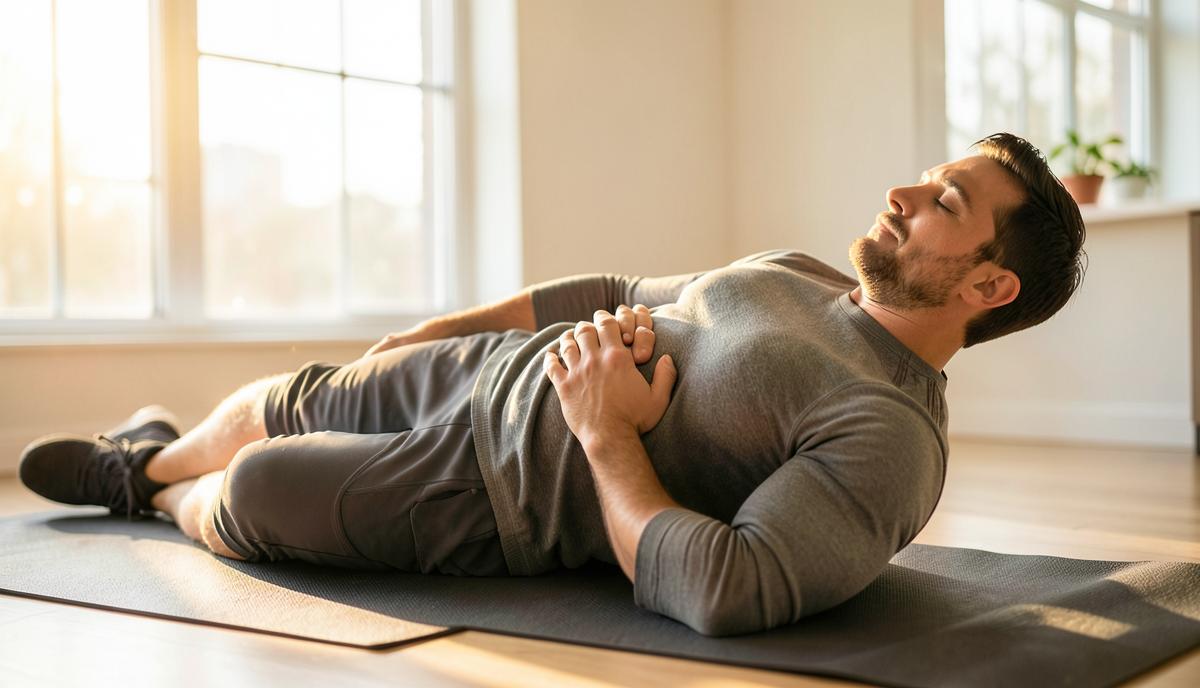
If so, deliberately reducing unnecessary tension may help you manage arousal more effectively. One simple approach is slow diaphragmatic breathing: allow the abdomen and lower ribs to expand during inhalation rather than taking shallow breaths into the upper chest.
The direct evidence that breathing alone substantially delays ejaculation is limited, so it should not be treated as a miracle technique. It has, however, been included in combined pelvic-floor interventions studied for premature ejaculation.
7. Reduce performance anxiety
Sexual performance anxiety creates an unhelpful loop: you worry about finishing too quickly, so you monitor yourself constantly, so sex becomes more stressful, so your arousal feels harder to control, so you worry even more.
Anxiety and premature ejaculation are closely associated, although that does not mean anxiety causes every case.
Instead of entering sex with the mental command “I must not come,” try putting more attention on physical sensations, your partner, your breathing, communication, pleasure, and the changes in your own arousal level.
Also remember that intercourse does not need to run uninterrupted from penetration to ejaculation. Pausing, changing stimulation or focusing on your partner does not mean something has gone wrong.
If anxiety is a major part of the problem, the guide on sexual performance anxiety goes deeper. Psychosexual counseling or therapy can also help when sexual anxiety, relationship difficulties or negative beliefs about sex contribute to the problem.

8. Change the intensity of sex instead of trying to endure it
A common mistake is treating sex like an endurance test: maximum stimulation, maximum speed, maximum effort — and then somehow trying not to ejaculate. That makes control unnecessarily difficult. Vary stimulation instead.
During penetrative sex you can change
- speed
- depth
- rhythm
- position
- duration of continuous penetration
You can also move temporarily from penetration to touching, oral sex, kissing, manual stimulation, or stimulating your partner. These changes allow arousal to rise and fall rather than climbing continuously.
Some sexual positions may make it easier to regulate movement or reduce stimulation, although individual responses vary considerably.
9. Address erection problems if they make you rush
Sometimes ejaculation control is not the only problem. A man who worries he will lose his erection may unconsciously rush: “I'm hard now, so I need to keep going before I lose it.” That makes pacing and arousal control considerably harder.
Erectile dysfunction and premature ejaculation can also occur together. Current European urology guidance recommends addressing erectile dysfunction and other relevant sexual or genitourinary problems when evaluating acquired premature ejaculation.
If this sounds familiar, working on erection quality and confidence may indirectly make it easier to stop rushing.
What should you try first?
You do not need to attempt every technique simultaneously. A practical progression looks like this.
- Learn your arousal pattern: spend several sexual experiences simply noticing when arousal shifts from easily controllable to difficult to control.
- Change pace earlier: slow down before you reach maximum arousal.
- Practice ejaculation control: introduce stop-start practice rather than waiting until sex itself to learn the skill.
- Reduce stimulation if needed: try a thicker condom if high sensitivity appears to be contributing.
- Work on tension and anxiety: notice breathing, pelvic-floor tension and performance anxiety.
- Investigate persistent problems: if control remains difficult despite practice, speak with a doctor, urologist or sexual-health professional.
Common mistakes when trying to last longer
- Waiting until the last possible second — once ejaculation feels inevitable, most techniques become much less useful.
- Turning sex into a stopwatch competition — control, pleasure, communication and satisfaction matter more than an arbitrary number of minutes.
- Using so much numbing product that you barely feel anything — the goal is to reduce excessive stimulation, not eliminate sensation.
- Assuming every ejaculation problem requires stronger Kegels — pelvic-floor function is more complicated than strength alone.
- Constantly monitoring whether you are “performing well” — excessive self-monitoring increases anxiety and makes sex feel like an exam.
When should you see a doctor?
Consider speaking with a doctor, urologist or sexual-medicine professional if
- you ejaculate sooner than you want during most sexual encounters
- you consistently feel unable to delay ejaculation
- the problem causes significant distress
- the problem appeared suddenly after previously normal ejaculation
- you also have erectile difficulties
- you have pain, urinary symptoms or other genital symptoms
- the problem is affecting your relationship or making you avoid sex
Persistent difficulty controlling ejaculation may represent premature ejaculation or another sexual-health issue that deserves proper assessment. Clinical evaluation typically considers your sexual and medical history rather than relying on ejaculation time alone.
The bottom line
If you want to last longer in bed, the most useful objective is better control — not simply more minutes. Learn what rising arousal feels like, reduce stimulation before ejaculation becomes inevitable, practice behavioral control techniques, and address sensitivity, pelvic-floor function, erection confidence and performance anxiety where relevant.
For occasional early ejaculation, these changes may be all you need. For a persistent problem that causes distress, effective professional treatments exist, and speaking with a sexual-health professional beats endlessly searching for new tricks.
Frequently asked questions
How long should a man last in bed?
There is no required duration of intercourse. Preferences vary between people and couples, and duration alone does not determine whether sex is satisfying. Clinical definitions of premature ejaculation consider ejaculation timing together with inability to delay ejaculation and personal distress.
Can you actually train yourself to last longer?
Some men can improve ejaculation control through behavioral practice. Techniques such as stop-start and squeeze have been used clinically, although research quality for behavioral interventions varies.
Can condoms help you last longer?
Yes. Condoms can reduce penile sensation, and thicker condoms are sometimes suggested specifically for men who want to delay ejaculation.
Do Kegel exercises help you last longer?
Pelvic-floor training may help some men, but the evidence does not support treating it as a universal cure. A 2026 meta-analysis found that isolated pelvic-floor training was less effective than some medical or combined interventions in men with diagnosed premature ejaculation.
Is finishing quickly always premature ejaculation?
No. Occasional early ejaculation is common. Premature ejaculation involves a recurring pattern of short latency, difficulty delaying ejaculation and negative consequences such as distress.
Train the muscle behind control
The Free Kegel Trainer guides you through squeeze and release intervals, day by day.
Start Day 1Sources
- European Association of Urology — Sexual and Reproductive Health: Disorders of Ejaculation
- International Society for Sexual Medicine — What Is Premature Ejaculation?
- NHS — Ejaculation Problems
- Mayo Clinic — Premature Ejaculation: Diagnosis and Treatment
- de Oliveira et al., Journal of Sexual Medicine, 2026 — Pelvic Floor Muscle Training for Premature Ejaculation
- Myers & Smith, Physiotherapy, 2019 — Pelvic Floor Muscle Training for ED and PE
- Cooper et al. — Behavioral Therapies for Premature Ejaculation: Systematic Review
- Cochrane Review — SSRIs for Premature Ejaculation in Adult Men
- ISSM — How Can Anxiety Influence Premature Ejaculation?
More Sexual Health articles
Medical disclaimer: This article is educational and not medical advice. Speak to a doctor or pelvic floor physiotherapist about persistent pelvic pain or urinary symptoms.