Sexual Performance Anxiety in Men: Causes and How to Overcome It
10 min read
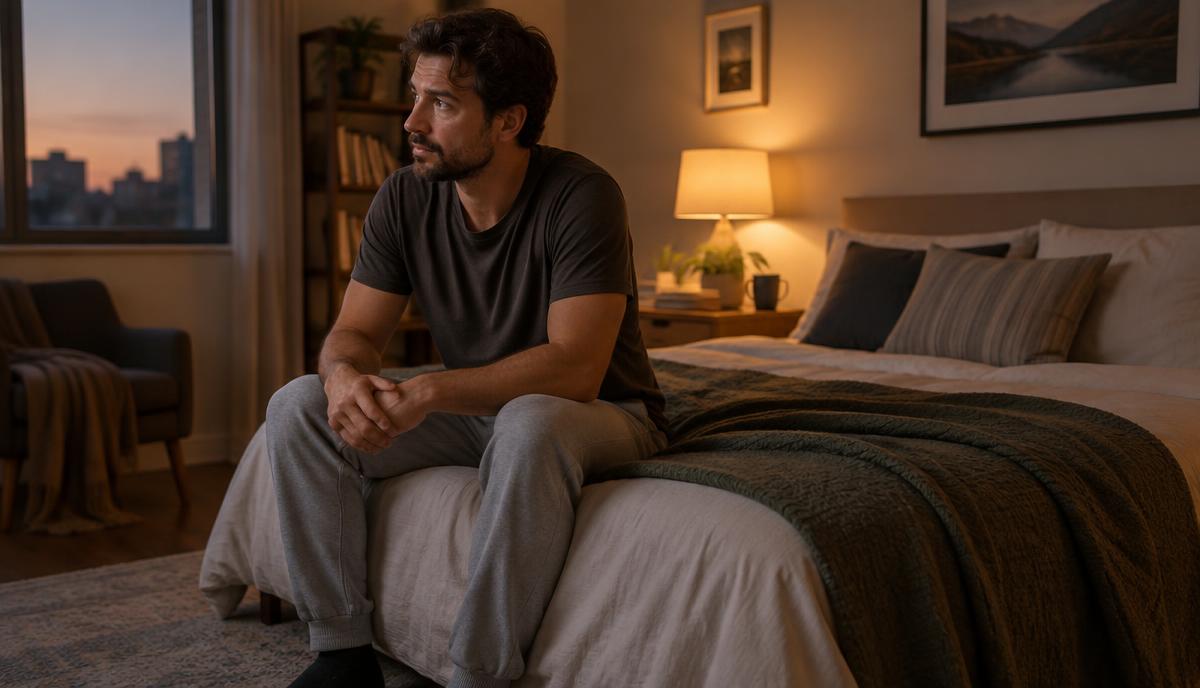
Sexual performance anxiety happens when worry about how you will perform interferes with arousal, pleasure, erections, ejaculation, orgasm or intimacy. Instead of noticing attraction and touch, your attention turns inward: Am I hard enough? Am I taking too long? What if it happens again? That self-monitoring can become part of the problem.
Quick answer: how to break the performance-anxiety cycle
- The cycle: worry about performance → monitor yourself during sex → become less absorbed in stimulation → something does not go as expected → worry more next time.
- Stop treating erection, penetration, orgasm or duration as a pass/fail test.
- Shift attention from monitoring yourself to physical sensation and connection.
- Temporarily reduce the pressure to perform — including taking penetration off the menu for a while.
- Communicate openly with your partner instead of hiding the worry.
- Use gradual exposure rather than avoiding sex.
- Consider cognitive behavioral therapy or sex therapy if the pattern persists.
- Investigate persistent erection or ejaculation problems rather than assuming they are purely psychological.
A calm body helps. Pelvic floor awareness and slow breathing are easy places to start — Free Kegel Trainer for Men.
What is sexual performance anxiety?
Sexual performance anxiety is anxiety specifically connected to sexual situations or anticipated sexual performance. Cleveland Clinic describes it as fear, embarrassment or worry that interferes with sexual interest, performance or pleasure. It can occur without any formal anxiety disorder, although the two often coexist.
In men, the common worries are:
- getting an erection
- losing an erection
- ejaculating sooner than desired
- taking too long to orgasm
- penis size or appearance
- satisfying a partner
- appearing sexually inexperienced
- being judged
- repeating a previous sexual difficulty
The defining problem is not simply feeling nervous. It is that anxiety starts changing how you experience or approach sex.
Anxiety is associated with sexual difficulties, particularly erectile problems, and psychological treatment is recognised in modern sexual-medicine guidelines. But performance anxiety does not mean a sexual problem is “all in your head” — physical and psychological factors frequently interact.
The sexual performance anxiety cycle
The most useful way to understand performance anxiety is as a feedback loop rather than a personality trait.
| Stage | What happens | Why it matters |
|---|---|---|
| 1. Doubt appears | You lost an erection once, finished sooner than expected, or felt awkward with a new partner | One ordinary event becomes a reference point |
| 2. You predict failure | Before the next encounter you already expect a problem | Sex starts with threat rather than desire |
| 3. You monitor yourself | Part of your attention becomes an observer checking firmness and timing | You are watching sex rather than having it |
| 4. Sexual attention drops | Attention is spent on threat monitoring rather than erotic cues | Sexual response depends partly on attention and engagement |
| 5. Normal variation feels like proof | A slight change in firmness reads as “it is happening again” | Ordinary fluctuation gets interpreted as failure |
| 6. Anxiety increases | The next encounter carries even higher expectations | This is how one bad night becomes a pattern |
Modern models of sexual performance anxiety emphasise exactly this interaction between anxiety, attention, self-evaluation and sexual functioning.
Signs of sexual performance anxiety
Possible signs include:
- worrying about sex hours or days beforehand
- constantly checking erection firmness
- focusing on how long you are lasting
- rushing sexual activity because you fear something will go wrong
- avoiding sex despite wanting intimacy
- difficulty staying mentally present
- repeatedly asking a partner whether everything is okay
- losing arousal when penetration becomes expected
- functioning differently during masturbation than partnered sex
- becoming aroused easily until you start thinking about performance
These patterns can suggest performance anxiety, but none of them proves anxiety is the only cause. Having reliable morning or masturbation erections while struggling with a partner is useful information, but it does not by itself rule out physical contributors.
Persistent erection problems deserve proper evaluation — see our guide to erectile dysfunction.
What causes sexual performance anxiety?
A single erection or ejaculation problem can create strong anticipatory anxiety. The original event may have been caused by:
A previous sexual difficulty
- fatigue
- alcohol
- distraction
- stress
- unfamiliarity with a partner
- relationship tension
- ordinary fluctuation in sexual response
The anxiety often continues long after the original trigger has disappeared.
Pressure to maintain an erection: trying to constantly verify that your erection is “100%” pulls attention away from arousal. If erection stability itself is the main issue, read our guide on how to maintain an erection rather than assuming anxiety explains everything.
Worry about ejaculating too soon: fear of premature ejaculation can turn sex into constant arousal monitoring. Some awareness is useful when learning ejaculation control; excessive monitoring creates stress. For the ejaculation problem itself, see our guides on lasting longer and the start-stop technique.
Body image or penis concerns: if you are thinking about how your body looks from your partner’s perspective, you are not attending to what your body is experiencing — the same observer mindset.
A new partner: new sexual situations introduce uncertainty, and wanting to impress someone easily turns into trying to prove something.
Relationship tension: unspoken conflict, fear of rejection or uncertainty about the relationship can make sexual situations feel less safe.
General anxiety: a systematic review found a substantial association between diagnosed anxiety disorders and erectile dysfunction, although the studies were heterogeneous and do not show that anxiety is the sole cause of ED.
How performance anxiety can affect erections
An erection is not something you can reliably command through conscious effort, so trying harder tends to be counterproductive.
Anxiety may interfere through several pathways: increased threat-focused attention, distraction from erotic cues, negative expectations, and physiological stress responses.
European Association of Urology guidelines recognise psychological and relationship factors as relevant to erectile dysfunction and recommend psychosocial interventions — including cognitive behavioral approaches and psychosexual education — in appropriate patients.
This does not mean every erection problem is caused by anxiety. Vascular disease, medication effects, neurological conditions, hormones and diabetes can also contribute.
How to overcome sexual performance anxiety
If successful sex requires an immediate erection, a perfectly firm erection, penetration, a specific duration and orgasm for both partners, you have created five separate opportunities to “fail”.
A better goal is shared pleasure, arousal, touch, curiosity and connection. Paradoxically, removing the requirement to perform often makes normal sexual responses easier.
2. Temporarily remove the thing you are testing. If intercourse has become a repeated erection test, agree with your partner that penetration is not the goal for a while. Focus on kissing, touching, massage, mutual stimulation and exploring what feels pleasurable. Psychosexual therapy has long used structured approaches that reduce performance demands and gradually rebuild confidence.
3. Move attention from evaluation to sensation. When your mind asks “am I hard enough?”, redirect attention to something concrete: warmth, pressure, breathing, your partner’s touch, what feels good right now. The goal is not to force anxious thoughts away — it is to stop treating every anxious thought as information that requires checking.
4. Stop repeatedly testing your erection. Touching or looking at your penis to check whether it is “still hard enough” reinforces the idea that something may be wrong. Let firmness fluctuate naturally and keep going with pleasurable activity instead of treating a dip as an emergency.
1. Stop defining successful sex by one outcome

5. Talk to your partner before the anxiety peaks. Research into sexual performance anxiety highlights its interpersonal dimension: what happens between partners influences how the anxiety is experienced and managed.
6. Do not rush because you fear losing your erection. “I’m hard now, we need to do this immediately” creates more pressure. An erection does not have to be preserved continuously from beginning to end.
7. Challenge catastrophic predictions. Performance anxiety relies on distorted conclusions: “if I lose my erection my partner will think I am not attracted to them”, “if I finish quickly once it will happen every time”, “I have to satisfy my partner perfectly”. CBT works partly by identifying and testing these beliefs rather than accepting them automatically. A 2026 systematic review of digital psychological interventions for male sexual dysfunction found that internet-based CBT, counselling and psychoeducation can improve aspects of sexual functioning and satisfaction, although the studies remain heterogeneous.
8. Use gradual exposure instead of avoidance. Avoidance gives short-term relief but strengthens the idea that sex is threatening. A better progression is affection without sexual expectations → sexual touch without penetration → increasingly sexual activity → intercourse when it feels natural. The exact pace should suit you and your partner.
9. Address an actual sexual dysfunction if one exists. Anxiety and physical problems reinforce each other. If you lose erections because of an underlying medical problem, telling yourself to relax will not solve it. Treating the underlying problem sometimes reduces the anxiety around it.
10. Consider sex therapy or CBT
Professional help is particularly useful once the pattern has become entrenched. Approaches may include cognitive behavioral therapy, psychosexual therapy, couples therapy, sexual education, communication work and gradual behavioral exercises.
European sexual-medicine guidance specifically supports psychosocial intervention in the treatment of erectile difficulties when appropriate.
What usually makes performance anxiety worse?
| Habit | Why it backfires |
|---|---|
| Trying harder to force an erection | Erections are not strength exercises |
| Constantly checking your penis | Monitoring increases attention to possible failure |
| Comparing every sexual encounter | Sexual response naturally varies |
| Using alcohol as your anxiety treatment | It may reduce inhibition, but higher amounts interfere with sexual function |
| Avoiding intimacy | Avoidance preserves the fear |
| Secretly taking erection medication without evaluation | Useful for diagnosed ED, but as psychological insurance it leaves the anxiety untouched |
Do not use prescription medication without appropriate medical guidance.
Is it performance anxiety or erectile dysfunction?
It can be both. A useful clinical evaluation looks at:
- when the problem began
- whether it occurs in every sexual situation
- erections during masturbation
- spontaneous or morning erections
- medications
- cardiovascular and metabolic risk factors
- neurological symptoms
- relationship context
- anxiety
- libido
Do not use one clue to diagnose yourself. For the medical condition itself, see our guide to erectile dysfunction.
When to see a healthcare professional
Seek professional help when:
- anxiety repeatedly prevents you from enjoying sex
- you are avoiding intimacy
- erection or ejaculation problems are persistent
- symptoms occur during masturbation as well as partnered sex
- sexual difficulties began after starting a medication
- you have reduced libido or other physical symptoms
- anxiety affects other areas of your life
- relationship conflict is becoming significant
A physician can investigate physical contributors, while a psychologist, certified sex therapist or other qualified mental-health professional can address the anxiety itself.
Sexual performance anxiety is common enough to be recognised clinically, but it is not itself a formal psychiatric diagnosis.
Frequently asked questions
Can sexual performance anxiety cause erectile problems?
Yes, anxiety can contribute to erectile difficulties, although persistent ED should not automatically be assumed to be psychological.
Why can I get hard alone but not with a partner?
The difference may involve pressure, attention, stimulation, relationship context or anxiety. It is a useful clinical clue, but it does not prove there is no physical component.
Does Viagra cure performance anxiety?
Erectile-dysfunction medication treats erection physiology, not anxious thoughts or performance pressure. Medication may help when ED is present, but the anxiety often needs separate treatment.
Can performance anxiety cause premature ejaculation?
Anxiety and premature ejaculation often occur together, but the relationship is complex. Persistent rapid ejaculation should be assessed on its own rather than blamed on anxiety by default.
Can sexual performance anxiety go away?
Yes. Many men improve by changing performance-focused habits, addressing an underlying sexual problem, communicating with their partner, and using psychological treatment when needed.
Train the muscle behind control
The Free Kegel Trainer guides you through squeeze and release intervals, day by day.
Start Day 1Sources
- Cleveland Clinic — How to Overcome Sexual Performance Anxiety
- European Association of Urology — Management of Erectile Dysfunction
- Sexual Medicine Reviews — Theoretical model and clinical approach to sexual performance anxiety
- Velurajah et al. — Erectile dysfunction in patients with anxiety disorders: systematic review
- Srisadono et al. — Internet-based CBT, counselling and psychoeducation for male sexual dysfunction: systematic review
- European Society of Sexual Medicine — Psychosocial approach to erectile dysfunction
- Journal of Sex Research — Sexual performance anxiety in adult couples
More Sexual Health articles
Medical disclaimer: This article is educational and not medical advice. Speak to a doctor or pelvic floor physiotherapist about persistent pelvic pain or urinary symptoms.