Tight Pelvic Floor in Men: Symptoms, Causes and Treatment
7 min read
A tight pelvic floor is not the same thing as a strong pelvic floor. Muscles are supposed to contract when needed and then return toward a relaxed resting state. With a hypertonic pelvic floor, the muscles stay excessively tense or cannot relax appropriately during urination, bowel movements or sex. Cleveland Clinic describes hypertonic pelvic floor as persistent pelvic-muscle contraction that can interfere with urinary, bowel and sexual function and may cause pain, and the same pattern of pelvic-floor overactivity and myofascial problems is recognised in men within modern chronic pelvic-pain guidelines. Because the symptoms overlap with many other conditions, pelvic-floor tightness should never be self-diagnosed from a single symptom.
Quick answer
- A tight, overactive or hypertonic pelvic floor means excessive resting tension or difficulty relaxing normally.
- In men it may contribute to pelvic or perineal pain, urinary urgency and frequency, and difficulty starting or maintaining flow.
- It can also contribute to constipation, incomplete bowel emptying, pain during or after ejaculation and erection-related discomfort.
- Many men describe a persistent, low-grade feeling of pelvic tension that never quite lets go.
- Treatment focuses on relaxation, coordination and the cause of the overactivity — not simply more strengthening.
Overactive pelvic-floor muscles need to learn how to let go. That is why “do more Kegels” is often the wrong starting point for a tight pelvic floor. Free Kegel Trainer for Men.
What does a tight pelvic floor mean?
“Hypertonic” simply means increased muscle tone. In practical terms, a tight pelvic floor may stay partially contracted when it should be resting, struggle to lengthen, contract at the exact moment it should relax, develop tender or painful areas, and coordinate poorly with the abdomen, diaphragm, bladder and bowel.
This is different from having powerful muscles. A tight muscle can still be weak, poorly coordinated or quick to fatigue — which is why tightness and weakness are often confused with each other.
Tight pelvic floor symptoms in men
Not every pain in these areas comes from pelvic muscles, but pelvic-floor myalgia can contribute to chronic pelvic-pain syndromes. Alongside pain, men commonly report a cluster of urinary, bowel and sexual symptoms.
Where pain is typically felt
- Perineum — the area between the scrotum and anus
- Rectum
- Penis
- Testicles
- Lower pelvis
- Hips
- Lower back
| Symptom | What men usually notice | Why the pelvic floor can be involved |
|---|---|---|
| Urinary frequency and urgency | Needing to go often, or with little warning | Overactive muscles can keep the bladder and urethra irritated and on alert |
| Difficulty starting urination | Standing at the toilet waiting for flow to begin | The pelvic floor has to relax to allow urination; tension or poor timing blocks it |
| Feeling incompletely empty | Finishing, then still feeling full | Poor relaxation may interrupt emptying — though several other causes exist |
| Constipation and straining | Hard, difficult or incomplete bowel movements | Passing stool requires the pelvic outlet to release as pressure rises from above |
| Painful ejaculation | Ache or sharp pain during or after climax | Cleveland Clinic lists pain with erection or ejaculation among possible symptoms |
Any of these symptoms that persist deserve evaluation rather than assumption. Erectile problems in particular have many possible explanations — see our guide to erectile dysfunction for how those are assessed.
What causes a tight pelvic floor?
There is rarely one single cause. Contributors described in clinical literature include chronic guarding in response to pain, prolonged pelvic muscle tension, musculoskeletal problems, surgery or previous pelvic injury, bowel straining, habitually holding urine or stool, stress-related muscle tension and existing chronic pelvic-pain conditions.
Cleveland Clinic also notes associations with prolonged sitting, posture or gait problems and other painful pelvic conditions. Importantly, identifying a possible contributor does not prove it caused your symptoms.
Tight pelvic floor and chronic pelvic pain
This relationship deserves special attention in men. Current European Association of Urology guidance recognises pelvic-floor overactivity and myofascial trigger points as relevant factors in chronic pelvic pain, and recommends that specialised physiotherapists address them when present.
The 2025 American Urological Association guideline on male chronic pelvic pain likewise includes individualised manual physical therapy as an option for men with pelvic-floor or abdominopelvic myalgia. Pelvic pain is therefore not something a man should try to “strengthen through”.
Is a tight pelvic floor the same as pelvic floor dysfunction?
Not exactly. A tight pelvic floor is one possible pattern of pelvic-floor dysfunction. Dysfunction can also involve weakness, poor coordination or a mix of problems in the same person — which is why assessment matters more than labels.
Are Kegels good for a tight pelvic floor?
Not automatically. A traditional Kegel deliberately contracts the pelvic floor. If your main problem is excessive resting tension or an inability to relax, adding more contractions without assessment may simply miss the underlying issue.
That does not make Kegels universally “bad”. Some men eventually need a combination of relaxation, coordination and strengthening. The correct approach depends on individual assessment — our plain-English guide to Kegel exercises for men covers the strengthening side.
How is a tight pelvic floor diagnosed?
There is no reliable online symptom quiz that can prove your pelvic floor is hypertonic.
What an assessment may include
- Medical history
- Urinary and bowel symptoms
- Pain pattern and triggers
- Movement and musculoskeletal assessment
- Evaluation of pelvic-floor contraction and, crucially, relaxation
- External or internal pelvic-floor examination when appropriate
- Tests aimed at ruling out other urinary, bowel or neurological causes
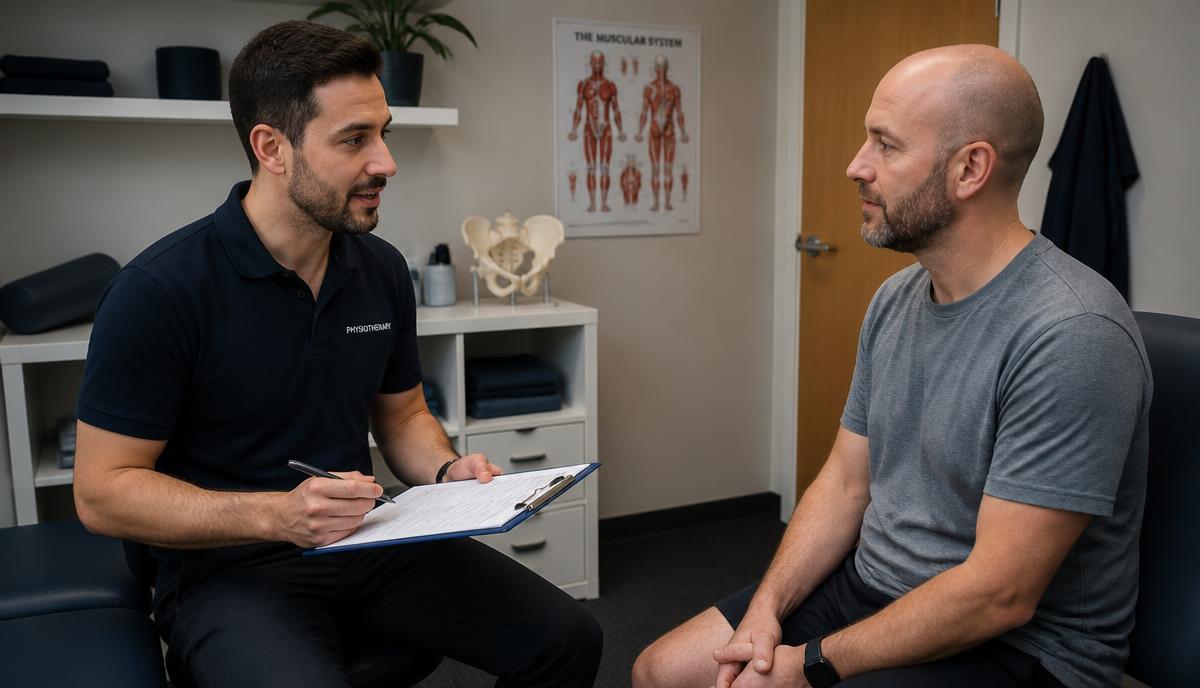
EAU guidance notes that appropriately trained clinicians or pelvic physiotherapists can assess male pelvic-floor function, including through rectal examination when clinically indicated.
How is a tight pelvic floor treated?
Treatment depends on what is driving the problem. Pelvic-floor physical therapy is one of the central conservative approaches, and Cleveland Clinic describes relaxation, stretching, biofeedback and physical therapy among treatments for hypertonic pelvic floor.
What therapy may involve
- Learning to identify excessive muscle activity
- Retraining relaxation
- Improving coordination and timing
- Manual myofascial techniques
- Biofeedback
- Hip, trunk and pelvic mobility work
- Posture or movement changes
- Individualised home exercises
Diaphragmatic breathing is often used as a practical way to rehearse abdominal and pelvic-floor relaxation. The pelvic floor normally changes position with respiration, and research in healthy men has demonstrated respiratory-related pelvic-floor muscle length changes.
“Reverse Kegels” — consciously allowing the pelvic floor to release or lengthen instead of contracting — are best viewed as a relaxation and coordination exercise rather than the literal anatomical opposite of every Kegel. Our reverse Kegel guide covers the technique.
Repeated straining can perpetuate pelvic tension, so treating persistent constipation is often part of the plan. Pelvic-floor treatment may also need to run alongside care for urinary disorders, bowel disorders, chronic pelvic pain, musculoskeletal problems or other identified conditions.
What not to do
- Don't assume more Kegels are always better — if the problem is overactivity, more contraction is not the priority.
- Don't force a reverse Kegel. Relaxation should feel like letting go, never like pushing down hard.
- Don't train through pain. Pain is a reason to reconsider the exercise and get assessed.
- Don't assume every pelvic symptom comes from the pelvic floor — urinary, prostate, gastrointestinal, neurological and sexual-health conditions produce overlapping symptoms.
When to see a healthcare professional
Arrange an evaluation for persistent
- Pelvic pain
- Pain with ejaculation
- Urinary urgency or frequency
- Difficulty urinating
- Constipation or incomplete evacuation
- Sexual problems associated with pelvic discomfort
Seek urgent medical care for an inability to urinate, fever with severe urinary or pelvic symptoms, significant bleeding, or sudden loss of bladder or bowel control.
Frequently asked questions
Can men have a tight pelvic floor?
Yes. Hypertonic and overactive pelvic-floor problems occur in men as well as women, and they are recognised within male chronic pelvic-pain guidelines.
Can a tight pelvic floor cause urinary problems?
It can contribute to difficulty relaxing during urination, along with frequency and urgency. These symptoms have multiple possible causes, so persistent problems should be evaluated.
Can a tight pelvic floor cause ED?
Pelvic-floor dysfunction can be associated with erectile problems, but ED has many potential causes. Pelvic-floor tightness should not be assumed to be the explanation.
Should I stretch a tight pelvic floor?
Pelvic rehabilitation may include relaxation and mobility work, but the right exercises depend on the cause and should never involve painful or forceful stretching.
How long does a tight pelvic floor take to relax?
There is no universal timeline. Recovery depends on the cause, how long it has been present, associated pain, adherence to treatment and whether other conditions are involved.
Train the muscle behind control
The Free Kegel Trainer guides you through squeeze and release intervals, day by day.
Start Day 1Sources
- Cleveland Clinic — Hypertonic pelvic floor
- Cleveland Clinic — Pelvic health rehabilitation
- EAU — Chronic pelvic pain: management
- EAU — Chronic pelvic pain: diagnostic evaluation
- PubMed — Male pelvic floor muscle length changes with breathing
- PubMed — The role of pelvic floor muscles in male sexual dysfunction and pelvic pain
More Sexual Health articles
Medical disclaimer: This article is educational and not medical advice. Speak to a doctor or pelvic floor physiotherapist about persistent pelvic pain or urinary symptoms.